
Welding Gun Heating Element Compatibility
Browse This Page
Compatibility Checklist
| Check | What to confirm |
|---|---|
| Identify the Complete Gun, Not Its Appearance | Photograph the nameplate, model, serial number, electrical rating and any revision marking. |
| Record the Symptom Without Declaring the Cause | Describe what happened: failure to start, airflow without expected heat, intermittent heating, unusual smell, an error indication or visible damage. |
| Make External Inspection Safe | Follow the exact tool’s shutdown and cooling procedure, then unplug before external inspection. |
| Use a Qualified Service Record for the Old Element | Have an appropriately qualified or authorised service person identify the existing element by the exact service instructions. |
| Match Electrical and Mechanical Requirements Together | The approved replacement must match the exact gun revision and its element specification: voltage, element rating, electrical connections, sensing or control arrangement, geometry, location and required insulation. |
| Distinguish Parts Identification from Fault Testing | Identification establishes which part is approved for the machine. |
| Confirm Repair, Testing and Future Reordering | Ask the qualified service provider to record the diagnosed fault, approved part and any associated components replaced. |
Identify the Gun Before Ordering an Element
Start with the gun label, revision, purchase record and fault description. Have qualified service identify the approved internal part and diagnose the fault. Voltage, element rating, connections and mechanical arrangement must match together; total gun power is not the element specification.
1. Identify the Complete Gun, Not Its Appearance
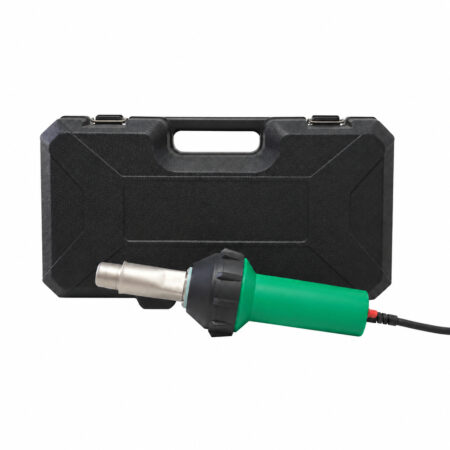
Photograph the nameplate, model, serial number, electrical rating and any revision marking. Record the purchase reference and supplied plug version. Standard Hot Air Welding Gun, higher-power welding gun configuration, Compact Hot Air Welding Gun y Plastic Welding Gun with Case need exact version identification before an internal part is selected. Body colour, case style or a familiar barrel diameter cannot identify the element. Keep the entire label legible, including markings that seem unrelated to the fault.


2. Record the Symptom Without Declaring the Cause
Describe what happened: failure to start, airflow without expected heat, intermittent heating, unusual smell, an error indication or visible damage. Note when it began and whether there was a power-supply problem, obstruction or impact. Stop using a damaged or abnormal tool and follow its instructions. A gun that stops heating does not necessarily have a failed element. Do not order a part solely from the symptom or continue operation to see whether the fault clears.
3. Make External Inspection Safe
Follow the exact tool’s shutdown and cooling procedure, then unplug before external inspection. Do not touch hot parts or open an energised tool. Inspect accessible cord, plug, housing and airflow openings only within the permitted operator checks. Record damage rather than attempting an improvised electrical repair. If the manual restricts internal inspection to service personnel, keep the tool closed. The information you can gather safely from labels and records is useful even when the element itself is not visible.
4. Use a Qualified Service Record for the Old Element
Have an appropriately qualified or authorised service person identify the existing element by the exact service instructions. The record should include its part marking, electrical specification, dimensional drawing, terminal arrangement, locating features and any revision dependency. Photograph a removed part only within that approved service process. Do not ask an untrained user to dismantle the gun to measure it. Keep related insulating tubes, seals, sensor interfaces and retention components identified because a replacement can depend on the complete assembly.
5. Match Electrical and Mechanical Requirements Together
The approved replacement must match the exact gun revision and its element specification: voltage, element rating, electrical connections, sensing or control arrangement, geometry, location and required insulation. A gun’s total nameplate power is not necessarily the element’s own rating. Equal wattage alone is insufficient, and a physically similar ceramic body may have a different electrical or terminal arrangement. Do not substitute a lower-cost generic element by dimensions or label similarity. Use the model-specific parts record and written service confirmation.
6. Distinguish Parts Identification from Fault Testing
Identification establishes which part is approved for the machine. Diagnosis determines whether that part is faulty and whether other components need attention. Electrical measurements, internal checks and post-repair tests belong to the qualified service procedure for the exact tool. Do not infer a fault from an element’s colour or make a live test from a general web tutorial. If the offered replacement has missing markings or a conflicting revision, keep it unapproved until the documented discrepancy is resolved.
| Selection point | What to check |
|---|---|
| Part identification | Establish the approved reference |
| Fault diagnosis | Confirm the actual cause through service |
| Verification | Complete the tool-specific checks |
An Element Has Its Own Rating
Leister’s element listing provides a part-specific voltage, rating and compatible-product list. Its TRIAC ST manual assigns repair to service. Use a qualified part and fault record before ordering an internal replacement.
7. Confirm Repair, Testing and Future Reordering
Ask the qualified service provider to record the diagnosed fault, approved part and any associated components replaced. Follow the exact manufacturer’s reassembly and post-repair verification before returning the tool to operation. Keep the test and service record with the gun’s serial and revision. For an ARIK parts enquiry, send the safe external photographs, purchase reference, fault description and identified service information. Order Welding Gun Heating Elements only against the confirmed host gun and part reference, with quantities and destination.
Related Products and Guides
Preguntas frecuentes
Does matching wattage make an element suitable?
No. Match the approved electrical, mechanical and revision requirements of the exact gun.
Should I open the gun to find the element number?
Only within its permitted service process and by the appropriately qualified person. Use labels and order records first.
Does no heat always mean a new element is required?
No. A qualified diagnosis must identify the fault before selecting a replacement.
What information do you need for a wholesale quotation?
Send the product names or models, configurations, quantities and delivery destination. You can include mixing buckets, spreaders, spiked rollers and shoes in the same enquiry. The applicable quantity tier, packing details and order conditions will be reviewed for the selected items.
Can you customize the logo or packaging?
Send your logo artwork, preferred placement, packaging requirements and estimated order quantity. ARIK will review the available options for the selected tools and confirm the sample requirements, order conditions and quotation before production.
Can I request samples before a bulk order?
Include the models and configurations you want to evaluate, the intended application and the delivery destination in your enquiry. Sample availability, cost and shipping arrangements need to be confirmed for the selected items before an order is placed.
Obtenga su presupuesto ahora
- Póngase en contacto con nosotros para obtener un presupuesto personalizado.
- Ahorre más con nuestros precios directos
- Precios al por mayor competitivos.
- Sin intermediarios, mejores ofertas.

