
Welding Gun and Nozzle Compatibility
Browse This Page
Compatibility Checklist
| Check | What to confirm |
|---|---|
| Identify the Complete Gun Version | Photograph the gun’s nameplate, model and serial or revision marking, rated voltage and the outlet with the existing nozzle removed only as the manual permits. |
| Make the Tool Safe for External Inspection | Finish the manufacturer’s shutdown and cooling procedure. |
| Describe the Connection Mechanism | Determine whether the nozzle is a push-fit with clamping, a threaded connection, or an accessory fitted onto a base nozzle. |
| Check Seating, Retention and Clearance | Compare the manufacturer’s drawing and approved part reference, including shoulder position, clamp position, fastener arrangement and any adapter. |
| Match the Rod Passage Separately | For a rod-feed nozzle, identify the rod material, nominal size and cross-sectional profile from its packaging or data. |
| Match the Air Outlet to the Floor | Use the exact flooring guide to choose the permitted outlet style, including any narrow-flow or detail requirement. |
| Keep a Usable Compatibility Record | Make one record containing the gun label, revision, outlet photographs, connection measurements with units, base nozzle or adapter, proposed nozzle, rod and floor product. |
Match Three Separate Interfaces
Identify the exact gun, outlet or base tube and proposed nozzle. Check mechanical connection and retention, the rod passage where present, and floor-specific air delivery. A nozzle that fits when cold still needs documented approval and the specified weld assessment.
| Selection point | What to check |
|---|---|
| Gun connection | Match the exact gun version |
| Rod passage | Check the specified rod feed where present. |
| Floor outlet | Match the flooring heat method |
1. Identify the Complete Gun Version
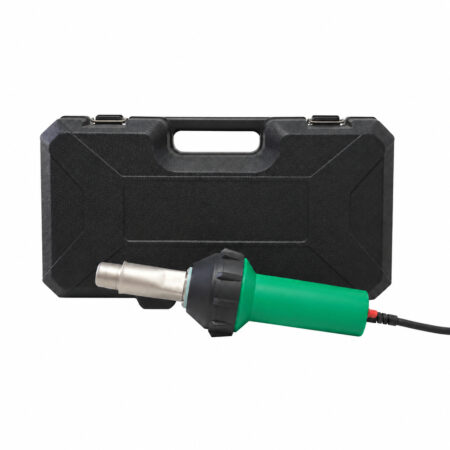
Photograph the gun’s nameplate, model and serial or revision marking, rated voltage and the outlet with the existing nozzle removed only as the manual permits. Record the current nozzle and any intermediate tube or adapter. Standard Hot Air Welding Gun, higher-power welding gun configuration, Compact Hot Air Welding Gun und Plastic Welding Gun with Case are starting descriptions; they do not identify one universal outlet. Keep the exact supplied version and order reference with the photographs.


2. Make the Tool Safe for External Inspection
Finish the manufacturer’s shutdown and cooling procedure. Disconnect from the supply before a cold external fit inspection or nozzle change as the manual requires. Do not touch or measure a hot outlet. Inspect the visible connection for wear, distortion, residue or a missing clamp. If removal requires a special method, use that method; do not force a stuck nozzle. This guide covers identification of accessible connections, not dismantling the heater housing or modifying a nozzle to make it fit.
3. Describe the Connection Mechanism
Determine whether the nozzle is a push-fit with clamping, a threaded connection, or an accessory fitted onto a base nozzle. Photograph both mating sides. For a cold cylindrical connection, record the relevant male outside diameter and female inside diameter, engagement length and seating features without scratching the surfaces. For threads, use the manufacturer’s designation and a suitable identification method for size, pitch and thread form. A ruler across the outside of a threaded fitting cannot establish the thread specification.
4. Check Seating, Retention and Clearance
Compare the manufacturer’s drawing and approved part reference, including shoulder position, clamp position, fastener arrangement and any adapter. The assembly must seat and be retained in the intended way without rocking or being forced. Check that the nozzle’s working angle and surrounding clearances suit the gun’s documented configuration. Do not bend, drill or add improvised packing to resolve a mismatch. A cold fit is only one mechanical check; it does not establish airflow, thermal behaviour or safe operating approval.
5. Match the Rod Passage Separately
For a rod-feed nozzle, identify the rod material, nominal size and cross-sectional profile from its packaging or data. Compare those details with the specified feed passage. Keep the feed opening distinct from the gun connection. Round and shaped rods can require different passages despite a similar dimension. Check feed direction and access on a permitted coupon. For an outlet-only nozzle, rod-feed dimensions do not apply; confirm its air-delivery role instead.
6. Match the Air Outlet to the Floor
Use the exact flooring guide to choose the permitted outlet style, including any narrow-flow or detail requirement. Confirm the material’s groove and rod method. An accessory that mechanically fits a gun may still direct too much heat onto a sensitive surface or be wrong for a coved detail. Keep the gun, nozzle and material approvals together. If a combination is not documented, obtain that approval before a powered trial; heating it until it seems to work is not a compatibility procedure.
A Real Three-Part Identification Example
Leister’s accessory catalog separates gun connections from rod-feed shapes and sizes where a feed passage is present. Identify the nozzle function before reading those entries. Keep the floor-facing outlet as a separate check, since gun seating alone does not settle heat delivery to the floor.
7. Keep a Usable Compatibility Record
Make one record containing the gun label, revision, outlet photographs, connection measurements with units, base nozzle or adapter, proposed nozzle, rod and floor product. Mark each check as confirmed, different or still unknown. Keep written confirmation of the intended assembly before ordering. After an approved assembly is available, verify it with the specified test weld and inspect the material result. Send the record with the selected Schweissdüsen, quantities and delivery details so the proposed part can be reviewed without relying on appearance.
Related Products and Guides
Häufig gestellte Fragen
Does matching the gun outlet diameter prove compatibility?
No. Check seating, retention, any approved adapter and the floor-facing heat delivery. For a rod-feed nozzle, also check the passage against the specified rod. Confirm the complete pairing and material process before the required test weld.
Is a nozzle’s rod size its gun connection size?
No. On a rod-feed nozzle, rod dimensions describe the feed passage; gun-side dimensions describe the mechanical attachment. Record them separately. An outlet-only nozzle has no rod-feed passage to match.
Can I use an external brand’s dimensions to approve an ARIK fit?
They help identify that external system. ARIK compatibility needs exact model and part evidence.
What information do you need for a wholesale quotation?
Send the product names or models, configurations, quantities and delivery destination. You can include mixing buckets, spreaders, spiked rollers and shoes in the same enquiry. The applicable quantity tier, packing details and order conditions will be reviewed for the selected items.
Can you customize the logo or packaging?
Send your logo artwork, preferred placement, packaging requirements and estimated order quantity. ARIK will review the available options for the selected tools and confirm the sample requirements, order conditions and quotation before production.
Can I request samples before a bulk order?
Include the models and configurations you want to evaluate, the intended application and the delivery destination in your enquiry. Sample availability, cost and shipping arrangements need to be confirmed for the selected items before an order is placed.
Holen Sie sich jetzt Ihr Angebot
- Kontaktieren Sie uns für Ihr persönliches Angebot.
- Sparen Sie mehr mit unseren Direktpreisen!
- Wettbewerbsfähige Großhandelspreise.
- Kein Zwischenhändler, bessere Angebote.

